


Listen. If your working thesis is that the artificial intelligence revolution is solely about hoarding GPUs, your idea is trash. You need to scrap it and start over. It is time to ruthlessly stress-test what you think you know about AI infrastructure and get your market intelligence to the point where it is bulletproof.
The prevailing, amateur narrative is that compute power—specifically processors from giants like Nvidia—is the only thing that matters. But the most advanced, mathematically flawless processor on the planet is nothing but an expensive space heater if it cannot access data fast enough to perform its calculations. This brings us to the real bottleneck choking the global tech ecosystem in 2026: memory. You may also like to read: Why AI Companies Are Losing Billions of Dollars Right Now.
We are currently living through what industry insiders are calling the “RAMpocalypse.” Driven by an insatiable AI demand for memory, a massive supply chain crisis is rewriting the economics of consumer hardware, data centers, and enterprise tech. If you want to understand where the technology sector is actually heading, you have to look past the processors and focus on the data pipeline. Here is the unvarnished truth about why AI companies are buying RAM, and why this shortage is going to fundamentally break the hardware market.
The GPU Illusion: Why Compute is Worthless Without Memory
To understand the panic buying happening at the enterprise level, we need to dismantle the mechanics of Large Language Models (LLMs) and generative AI.
When you query an AI model, that model cannot fetch data from a slow, traditional hard drive. To generate human-like text, render hyper-realistic video, or calculate complex algorithmic weights in real-time, the entire model must be loaded directly into the system’s volatile memory. This is the “Memory Wall”—the physical limit of how fast a system can move data between the processor and the RAM.
High Bandwidth Memory (HBM): The Kingmaker
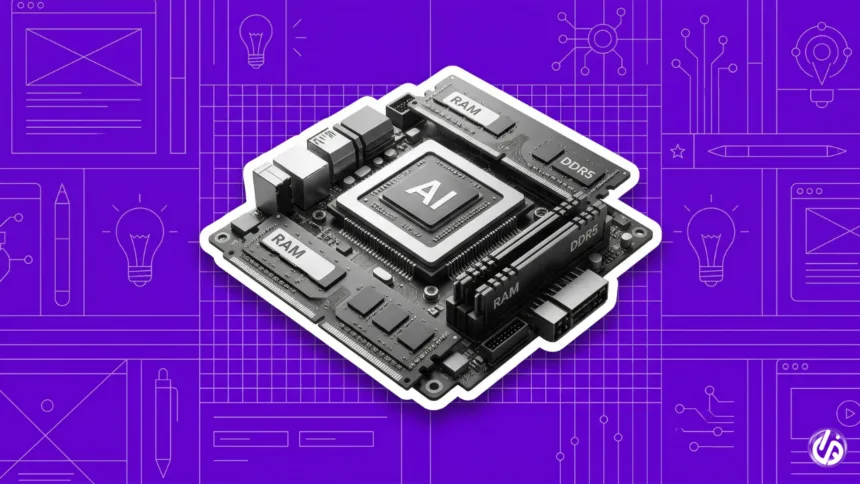
This is where standard memory fails and High Bandwidth Memory (HBM) enters the picture. HBM is a specialized form of RAM that is vertically stacked and placed physically closer to the GPU. This drastically reduces latency and massively widens the data pipeline.
AI data centers cannot function without HBM. When companies like OpenAI, Alphabet, or Meta purchase tens of thousands of Nvidia AI accelerators, they aren’t just buying the compute chip; they are buying the massive allotments of HBM intricately tied to them. Because producing HBM is incredibly complex and yield rates are lower than standard DRAM, the global supply is intensely constrained.
There are only three primary suppliers of HBM on earth: Micron, Samsung, and SK Hynix. Right now, major AI firms are buying up their entire production capacity years in advance. They are hoarding memory because whoever controls the highest-bandwidth infrastructure controls the speed at which their AI models can learn and infer. If your AI platform runs out of memory, your product dies. It is that simple.
The Enterprise Data Center Squeeze
The enterprise scramble for memory is not a speculative future threat; it is an active crisis. Top engineers running AI studios have explicitly stated that the compute bottleneck is massively under-appreciated by the public, noting that the gap between hardware supply and AI demand grows by a single-digit percentage every single day.
Capital Expenditure Explosions
Look closely at the financial realities. Why are AI companies buying RAM at any cost? Because the alternative is losing the AI arms race. This panic buying has triggered an absolute explosion in capital expenditures (CapEx).
In early 2026, memory manufacturers like Micron announced multi-billion-dollar boosts to their CapEx spending just to try and build enough manufacturing capacity to meet the backlog. We are seeing unprecedented investments pouring into high bandwidth memory AI data centers. However, building a new semiconductor fab takes years. You cannot simply flip a switch and double global RAM production overnight. This means that the tech titans with the deepest pockets are effectively strangling the supply, leaving everyone else to fight over the scraps.
Beyond the Cloud: The On-Device AI Tax
The crisis isn’t isolated to massive, warehouse-sized data centers. The push for “Edge AI”—running artificial intelligence locally on your own devices rather than relying on a cloud server—is supercharging the AI demand for memory on the consumer front.
The Extinction of the 8GB PC
For the better part of a decade, 8GB of RAM was the acceptable baseline for a standard consumer laptop. That era is officially dead. The aggressive rollout of AI PCs—machines equipped with dedicated Neural Processing Units (NPUs) designed to run integrated AI assistants like Microsoft Copilot—has fundamentally broken the old minimum requirements.
AI models load their parameters directly into system memory. If you try to run a local LLM on an 8GB machine, the system will instantly bottleneck, crashing applications and grinding your workflow to a halt. Consequently, AI PC RAM requirements have violently shifted. 16GB is now the absolute bare minimum just to boot modern AI-integrated operating systems effectively, and power users are being told that 32GB to 64GB of DDR5 or LPDDR5X memory is necessary to future-proof their hardware. This forced hardware obsolescence is forcing PC manufacturers to buy double or quadruple the amount of memory per unit just to stay relevant.
Driverless Cars and Humanoid Robots: The 300GB Reality
If you think laptops are the primary issue, your scope is too narrow. The next frontier of AI is physical embodiment, and the memory requirements are staggering.
Major memory executives have recently pointed out that the industry is entirely unprepared for the next wave of RAM-hungry devices: autonomous vehicles and AI-powered humanoid robots. An advanced, Level-4 autonomous vehicle or a commercially viable humanoid robot acts essentially as a high-end AI data center on wheels (or legs). To process real-time spatial data, navigational physics, and generative decision-making without lag, these edge devices will require upwards of 300GB of high-speed RAM per unit. As automotive and robotics companies enter the chat, the competition for memory allocation will become utterly bloodthirsty.
The Supply Chain Cannibalization
When AI giants open their checkbooks to buy every available HBM and high-density DDR5 module on the market, it creates a cascading failure across the rest of the global supply chain. Memory fabrication plants only have so much silicon wafer capacity. To produce the highly profitable HBM chips that AI companies are begging for, manufacturers are actively shutting down production lines dedicated to standard, older-generation DRAM and NAND flash memory.
Pushing Out Consumer Electronics
This cannibalization is actively destroying product roadmaps for everyday consumer electronics. Because memory prices are skyrocketing—with some analysts predicting zero price corrections through 2027—smaller consumer electronics manufacturers are facing an existential threat.
The margins on budget smartphones, smart home devices, and IoT hardware are already razor-thin. When the cost of memory doubles, these companies cannot absorb the loss. Industry analysts are already warning that by the end of 2026, numerous consumer electronics manufacturers will either be forced to exit product lines entirely or face bankruptcy due to the AI memory crisis.
Even titans of the entertainment industry are not immune. We are already seeing credible leaks suggesting that major gaming console manufacturers are considering delaying next-generation platforms like the PlayStation 6 to 2028 or 2029. Why? Because the cost of outfitting a $500 gaming console with enough fast memory to run next-gen graphics is completely unviable when AI data centers are willing to pay a 500% premium for those exact same chips.
Conclusion: The Memory-Bound Future
If you are a strategist, a developer, or an investor, you must stop viewing the AI boom purely through the lens of processing power. Stress-test your models. Run the numbers on hardware availability. The ruthless reality of 2026 is that the artificial intelligence industry is entirely memory-bound.
Why AI companies are buying RAM is no longer a mystery; it is a survival tactic. They are securing the data pipelines required to ensure their expensive GPUs do not sit idle. In doing so, they have triggered a RAMpocalypse that is fundamentally altering the global tech supply chain. The companies that successfully secure their memory allocations will define the next decade of AI evolution. Those that fail to see the bottleneck will simply run out of space to think.
Never miss an update! Turn on our post notification and follow us @SparktopusBlog on all social media to stay updated!